

The roles of the PMO (Project Management Office)

In a context where projects are multiplying and becoming more complex, the PMO is emerging as a pillar of governance and performance.The structure, harmonization, and optimization of the management of programs, portfolios and projects. Between roles, typologies, concrete contributions and risks to avoid, this article will help you understand why the PMO has become indispensable for effectively orchestrating the success of projects.
The PMO is the person (or group of people) in charge of managing programs, portfolios, or projects within a company. It can be attached to a directorate, a department, or dedicated to a specific portfolio, in any structure that operates in "project" mode.
PMO typologies
Organizations use different types of project management offices (PMOs), depending on their needs, objectives, and strategy. The PMO itself takes different forms, depending on its scope and position within the organization.
Le Enterprise or corporate PMO The Enterprise Performance Management Office (EPMO) is implemented globally to oversee all programs, projects, and portfolios. It ensures the strategic alignment of initiatives with business objectives and guarantees the achievement of expected benefits.
On a more limited level, the divisional or organizational PMO operates within a specific department (for example an IT-PMO or a Design-PMO). He/She supports the implementation of projects and programs specific to his/her department, while applying the governance standards established at the global level.
Le Project PMOThis unit, on the other hand, is created for a single, large-scale project or program. It provides operational and administrative support, and ensures control, monitoring, and reporting throughout the project lifecycle.
Le PMO support acts as an internal consultant, offering ad hoc or permanent support to project managers and teams, particularly on methodological and organizational aspects.
Finally, the Center of Excellence in Project Management (PMCOE) focuses on structuring and disseminating standards: it defines methodologies, processes, tools, key skills and best practices, while capitalizing on lessons learned to strengthen the organization's maturity in project management.
Project portfolio management
Beyond managing individual projects, the PMO plays a key role in project portfolio management. This activity consists of breeding, prioritize et arbitrate all initiatives in order to ensure their alignment with the company's strategy and the organization's actual capacity to carry them out.
The PMO brings a global vision and consolidated portfolio: expected value, costs, risks, dependencies, team workload, and associated benefits. This facilitates decision-making. by helping to answer essential questions: which projects to launch, which to postpone, which to stop.
Portfolio management is a dynamic exercise, requiring regular reviews and continuous adjustments.
By ensuring this balance between strategic ambition and operational feasibility, the PMO directly contributes to maximizing the value created by project investments.
A day in the life of a PMO
Standardization of processes
- Establish and maintain project management methodologies (Agile, Waterfall, hybrid)
- Ensure consistency in project execution
- Standardize the qualification of projects (strategic, major, minor, demand…)
- Clarify the objectives of the projects (organizational, technical, material, etc.)
Monitoring, management and reporting
- Collect and consolidate progress data
- Define key performance indicators (KPIs)
- Fueling governance (CoPil, CoProj)
- Highlighting the risks and opportunities
Resource management
- Optimize the allocation of human, financial, and material resources
- Adapt their distribution according to workload and priorities
Support for project teams
- Supporting project managers in their missions
- To provide methods, tools and a working framework
Continuous improvement
- Analyze past performance and lessons learned
- Implement changes to the processes and tools used
Traps to avoid
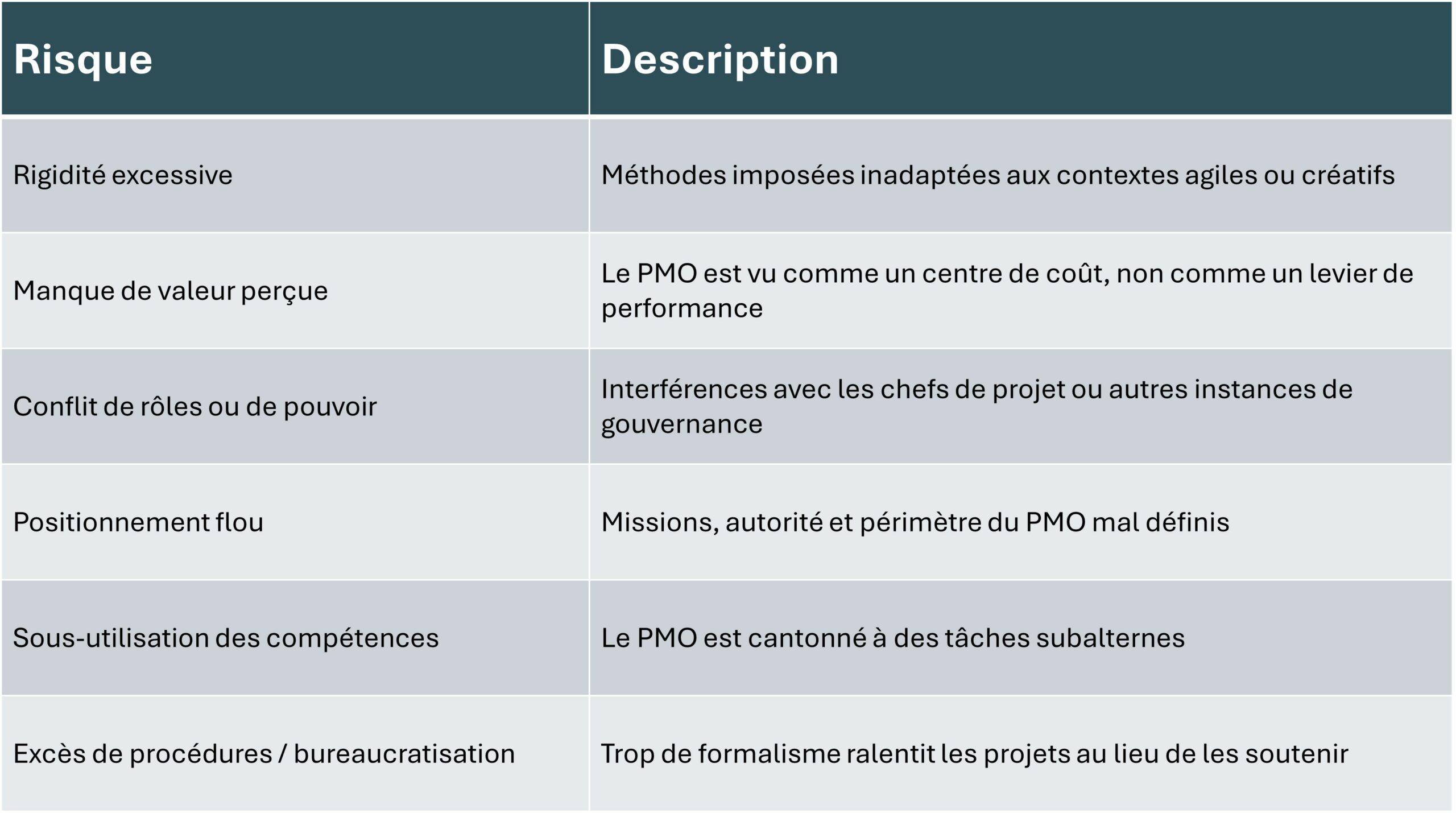
What does the PMO bring in?
The PMO creates measurable value across several key areas:
- Consistency & quality : standardized processes, fewer failures, better controlled deliverables and better qualified projects.
- Visibility & transparency : reliable reporting, a clear view of progress and faster, more informed decisions.
- Resource optimization : better allocation, less waste, more operational efficiency.
- Risk management : anticipation, mitigation plans and reduction of negative impacts.
- Easy communication : information that circulates, enhanced collaboration between teams and management.
- Help with the decision : strategic support to prioritize, direct resources and maximize the value created.
The PMO that stands the test of time
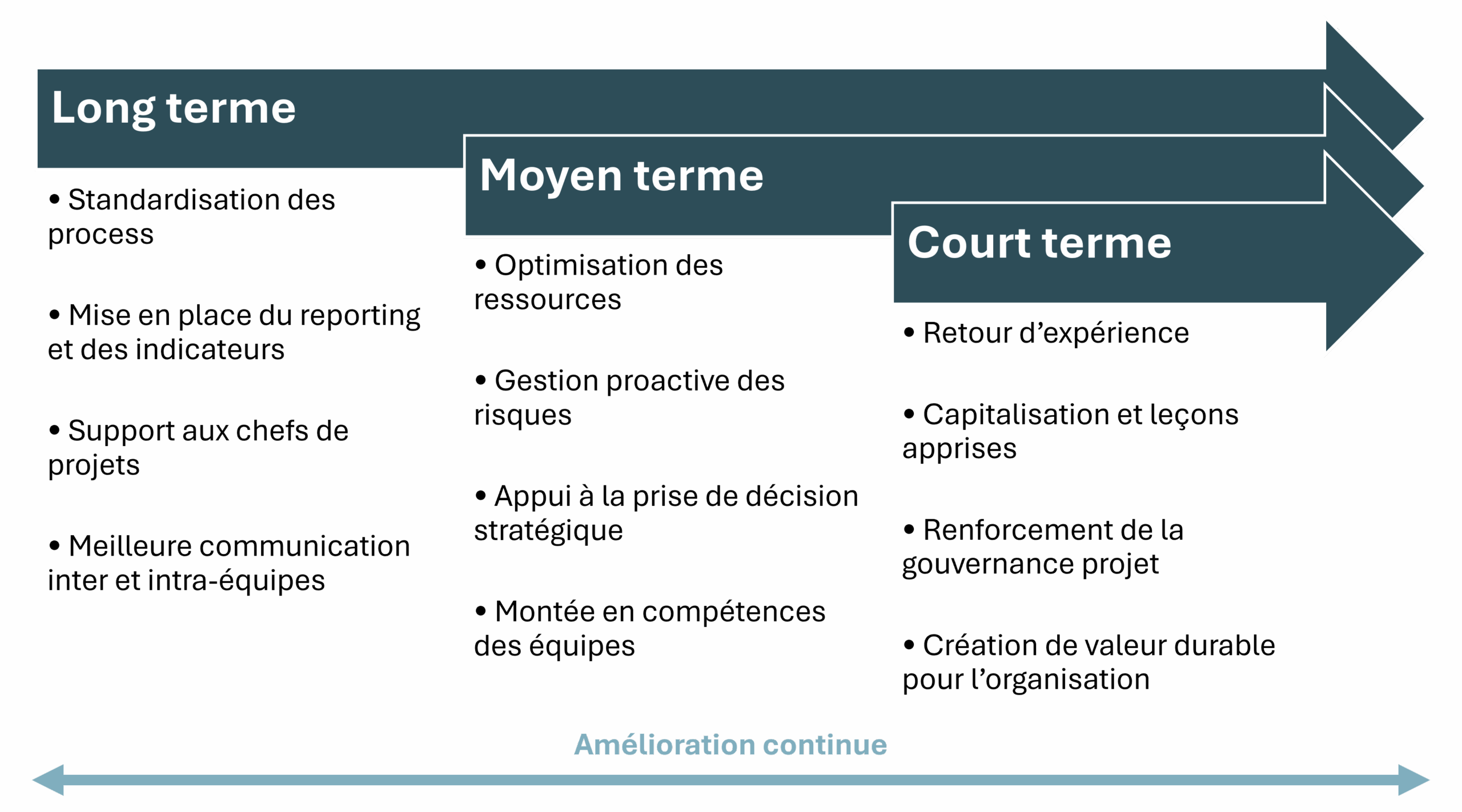
Conclusion
Working without a PMO: a risk, not a choice!
Without a PMO, organizations are exposed to structural dysfunctions: working in silos, inconsistencies in project sizing and management, lack of coordination between business lines and services, and weakened communication.
These shortcomings often lead to resistance to change, unreliable monitoring indicators and, ultimately, a loss of efficiency and visibility.
The PMO: a strategic lever for success!
The PMO positions itself as a key player in project performance. It ensures the consistency, quality, and strategic alignment of initiatives with the company's objectives.
However, setting up a PMO requires taking into account certain potential obstacles: the maturity level of the organization, change management, as well as the costs and implementation times.
In short, the PMO is not just an administrative support: it is a sustainable strategic lever, guaranteeing the control, consistency and performance of projects.